Origins are mystical. They tend to be elusive and therefore easily exploited. If not completely invented, they are often embellished. Like this ‘first’ blog entry, which is actually the eleventh or twelfth. I decided to pre-date it in order to have a nice beginning. Why? Well, why is the origin of things so important to us?
My first thought was that it had to do with time and our linear understanding of it. Things come into being, exist, and then cease to exist. But if we had a cyclical understanding of time, beginnings would not be isolated entities, but inextricably linked to ends. In an eternally recurring world, the question of origins would become obsolete. Instead, everything would always be in the middle.
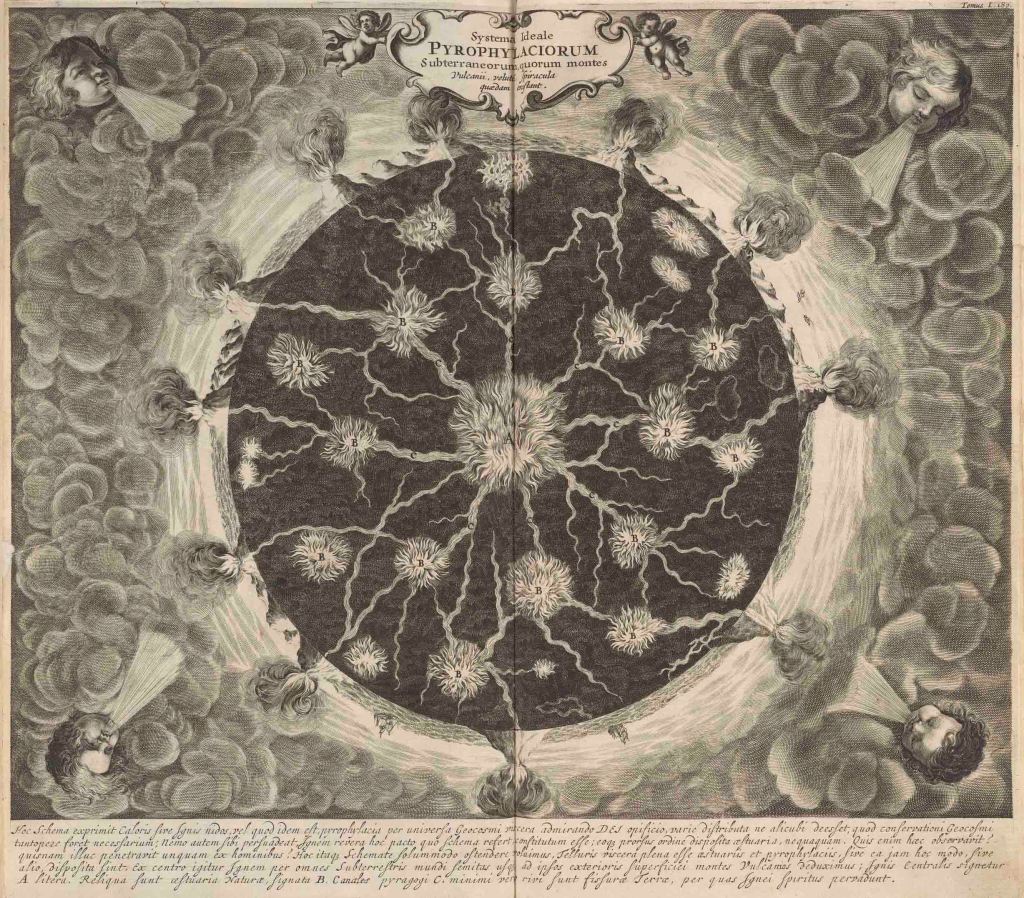
But as I looked at this illustration from Athanasius Kircher’s Mundus Subterraneus, I realized that the spatial implications of humanity’s metaphysical quest for origins are as crucial as the temporal ones. By digging through sediments of earth and piles of archival documents, the archaeologist and the historian, respectively, aim to find something original “underneath,” “inside,” or even “at the core.“ This suggests that the truth is hidden. Hidden in the depths of the archive, the soil, the layers of irrelevance that hide the real knowledge. Supposedly there is substance to be found in the depths, while the surface offers at best superficial insights.
In addition to deep and shallow, Kircher’s depiction also suggests a dichotomy between center and periphery. Two centuries after his speculations about the subterranean world, the French novelist Jules Verne again explored the origins of volcanoes in his book Journey to the Center of the Earth. But what his protagonists found there was not a vast and immensely hot reservoir of lava, but a hidden world where dinosaurs still lived. An earlier (more original) version of the world had been preserved on the same planet, and somehow it had escaped evolution. Time must have stood still at the center of the Earth, or functioned in a non-linear way.
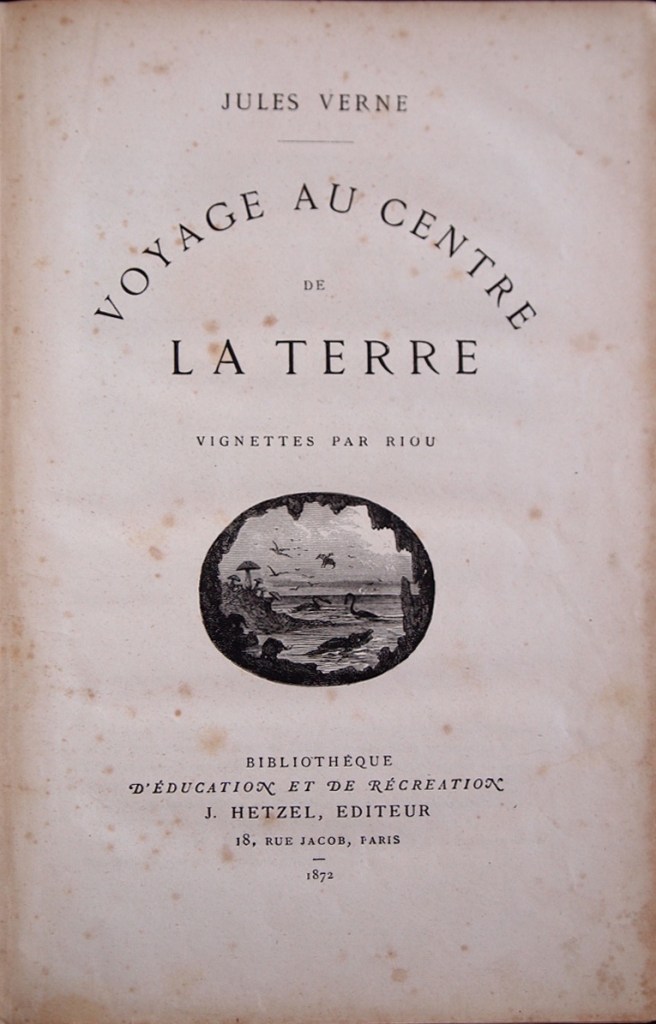
On the surface, Verne’s novel appears to be a story about the search for origins. However, the image of a second world within the existing one actually suggests an alternative model to origin-driven thinking. Instead of up/down, center/periphery, depth/surface, the spatial metaphors for this alternative are “parallel,” “along,” “next to,” etc. Instead of digging, knowledge is acquired by moving sideways, like a rhizome.
To be clear, I do not mean to discredit the desire to search for beginnings. In fact, I am a digger myself. And yet, digging for truth and going down the rabbit hole may turn out to be two sides of the same coin.
 Patrick Düblin
Leave a comment