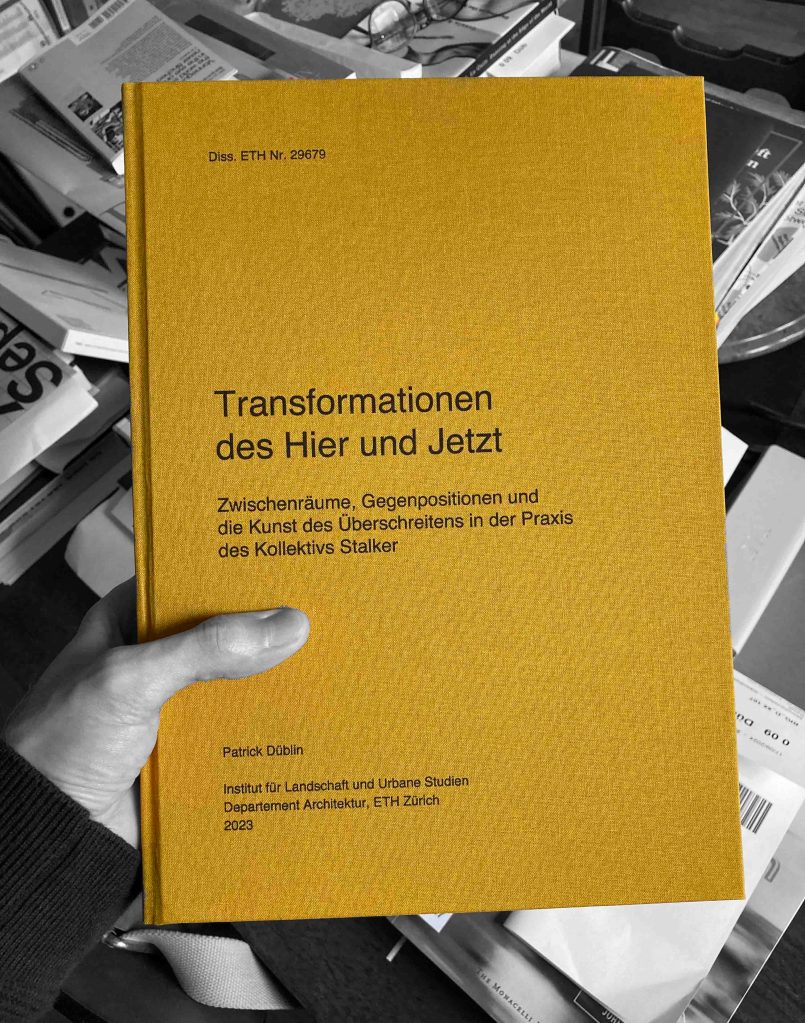
In my freshly printed dissertation “Transformations of the Here and Now. Interstices, Counterpositions and the Art of Transgression in the Practice of the Collective Stalker,” I examine the eclectic legacy of the group of Italian artists and architects known as Stalker. Focusing on the period from 1990 to 2008, this dissertation provides the first comprehensive analysis and historicisation of the collective’s work.
Emerging from a student protest at the architecture faculty of the Sapienza University in Rome in 1990, Stalker developed a practice of walking through and mapping neglected and forgotten peripheral zones of European metropolises that was first put into action in 1995. From 1999 onwards, the group complemented this physical approach to (peri-)urban space with a practice of creating selforganised places for marginalised groups in Rome, such as the Kurdish cultural and reception centre Ararat. In 2002, Stalker founded Osservatorio Nomade to carry out longer-term projects, including an attempt to rehabilitate the reputation of the neglected Corviale housing complex through initiatives “from within”. The group’s long-standing commitment to improving the situation of the Sinti and Roma communities culminated in the 2008 construction of the prototypical Savorengo Ker house, which was a manifesto against the displacement of the Roma into container camps and in favour of a dignified and self-determined life for the disenfranchised.
This research describes Stalker’s approach as “non-invasive” intervention in situ and with simple means, always characterised by the intention of transforming the “here and now”. The consistent aim of realising micro-utopias in the present instead of creating grand projects for the future reveals the collective’s creative and political attitude as well as its decidedly critical stance towards architecture. Shedding light on performative approaches to reinterpreting the city of Rome, intercultural and participatory initiatives for urban design, as well as modes of activist engagement with underprivileged groups are key focuses of this study. The question of the emancipatory potential of education always underlies these actions, ranging from the break with the “bad” architecture school to the development of a contrary counter-programme and the only partially realised vision of a “Nomadic University”. The dissertation explores the unstable liminal position that Stalker maintain between art, architecture, and activism. It points out the potential as well as the contradictions of the collective’s transgressive way of operating and discusses the advantages and disadvantages of collective authorship.
 Patrick Düblin
Leave a comment