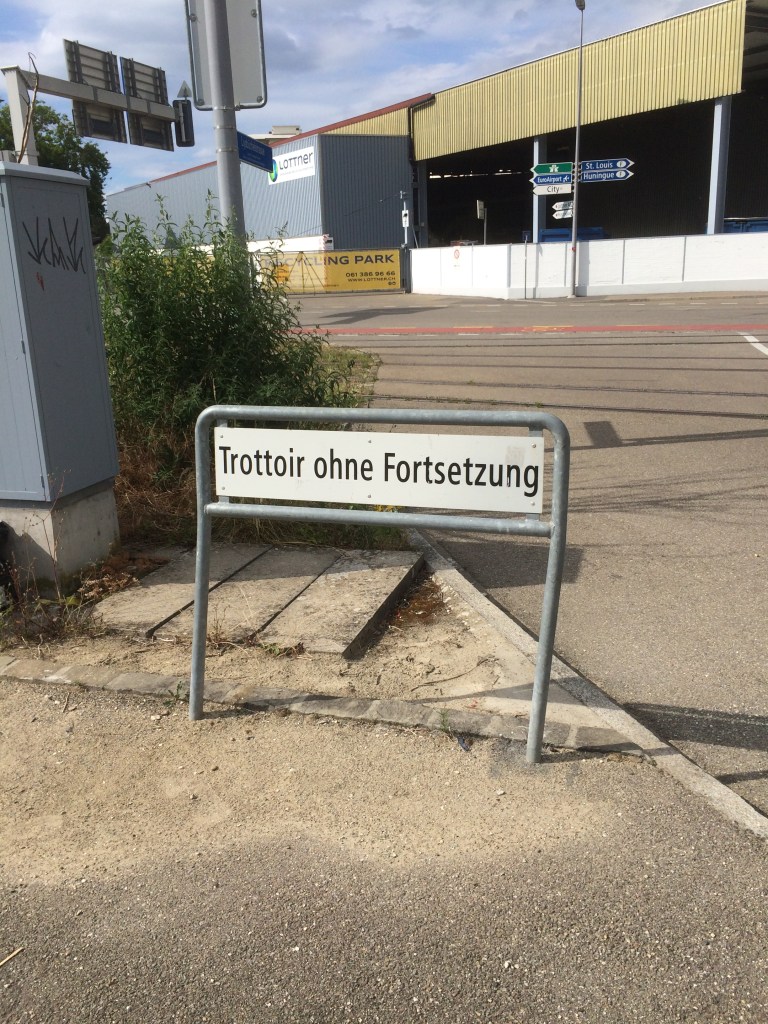
In the Middle Ages, the boundaries of the city were clearly defined by the city walls. They made the distinction between urban and non-urban/rural unquestionable, and their effect went far beyond spatial aspects. Beyond the wall, different laws applied, currencies changed, etc. In contrast, today’s sprawling cities seem to disregard all boundaries, natural or artificial, seamlessly blending urban, suburban, and rural textures. So where does the contemporary city end?
Most of the time, it’s hard to define the boundary exactly – what parameters should be taken into account? What are the limits of urban qualities? And what qualifies an end? On rare occasions, however, these academic considerations can vanish abruptly when the end suddenly appears in front of you, asserting itself with the confidence of a city wall. “Trottoir ohne Fortsetzung” – “Sidewalk without continuation.” The message is unintentionally hilarious because it not only states the obvious, but does so at the very end, when the information has become redundant, presenting the pedestrian with a fait accompli.
There is also an apologetic aspect to this. Indeed, the sign may seem like an embarrassing admission of failure on the part of the traffic department. (We just couldn’t figure out how to continue it!) Traffic is supposed to flow, and that includes pedestrians. If congestion is a problem for traffic planners, an involuntary dead end is probably a sacrilege. Voluntary or not, the city and its planners have erected a monument to their own limitations. By declaring the end of the sidewalk, they have also declared the end of their control over the city. In this respect, the sign might actually be communicating: “This is the end of the planned and regulated city.” And to some extent it is, as the wasteland on the left suggests.
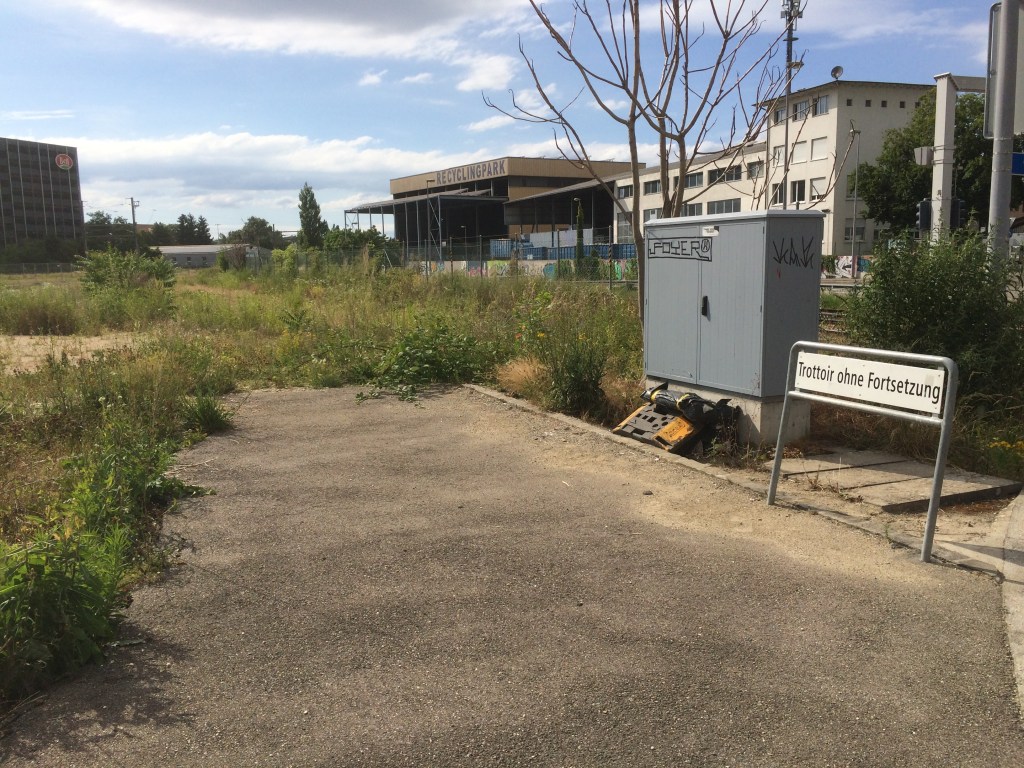
In fact, endings are rarely radical cuts to black. More often than not, they are merely thresholds to new beginnings. As a pedestrian, your actions ultimately determine the meaning of the sign. You can either turn around and walk back the way you came, acknowledging the dead end. Or you can continue beyond the designated walking area, perhaps even stepping off the asphalt and into the wild and uncultivated grounds of terrain vague.
I took these photos two years ago. Now the area is under construction again and this rare piece of wilderness is disappearing. The sidewalk will probably be completed or redesigned any moment, and with it, the bizarre and poetic street sign will soon be gone.
Far from the circular wholeness and firm security of the ancient city walls, today’s urban ends are unexpected encounters with an elusive phenomenon – finding it is as serendipitous and surprising as bumping into a deer on a walk in the woods.
 Patrick Düblin
Leave a comment